Ensuring quality, credible, and recognised assessments across South Africa.

Full FET Phase subject offering (Grades 10–12)
Guides and subject-specific programmes
Aligned with national and international standards
NSC Certificates accepted nationwide

The South African Comprehensive Assessment Institute (SACAI) is a private assessment body accredited by Umalusi to assess the National Senior Certificate (NSC) and General Education and Training Certificate: Adult Basic Education and Training (GETC: ABET). The assessment body offers these qualifications to a diverse group of candidates.
SACAI addresses the growing demand for quality and exceptional customer care in external summative assessments for educational institutions and training providers in distance education.
SACAI is a South African Assessment Body that assesses the NSC and GETC: ABET qualifications. SACAI stands for the South African Comprehensive Assessment Institute.
Assessment bodies conduct national external examinations and ensure the quality of internal assessments for specific qualifications.
SACAI conducts the National Senior Certificate (NSC) and General Education and Training: Adult Basic Education and Training (GETC: ABET) examinations for all its registered candidates and quality assures (moderates) the internal assessments of all the institutions registered with SACAI.
SACAI is accredited by Umalusi to assess the NSC and GETC: ABET qualifications
No, SACAI does not accredit any institutions. SACAI does, however, register the following two types of institutions:
SACAI assesses the following FET subjects listed in the National Policy pertaining to the Programme and Promotion requirements of the National Curriculum Statement. Please note that subjects not reflected on this list may be offered upon request, but is subject to SACAI’s approval and may incur additional fees.
Subjects in bold have examination papers sourced from either the DBE or IEB.
Yes. Teacher Support Guides (TSGs) are made available to all SACAI-registered institutions.
No. It is the responsibility of each independent school and distance education provider to issue quarterly progress reports to the learners enrolled with them.
Candidates who pass the SACAI NSC examinations are issued with matric certificates by Umalusi, the Quality Council responsible for quality assuring the NSC qualification. Umalusi matric certificates are accepted by all South African universities.
SACAI communicates with universities via Universities South Africa (USAf). Kindly inform SACAI as soon as possible (info@sacai.org.za) should SACAI not be listed on a specific university’s database in order for the matter to be addressed with USAf.
SACAI’s past papers are all available on this website.
A distance education provider does not offer teaching and learning at a specific physical location. Distance education is delivered online or via correspondence. Distance Education Providers (DEPs) are institutions that register learners for the NSC qualification (Grades 10–12) through distance (home- or online) education. The DEP provides the learner with curriculum materials and takes responsibility for the learner’s assessment throughout the year. SACAI externally moderates these assessments.
An independent School is a school that is registered with the local Provincial Education Department (PED) and has the required EMIS number as proof of such registration. Independent Schools must also be accredited by Umalusi.
A repeater centre is an institution catering specifically for learners that failed Grade 12 or who wish to better their marks for a specific subject. Repeater Centres are also known as matric rewrite centres.
The closing date for the registration process is 1 October annually.
Kindly send an e-mail detailing your query to Ms Ronel Smart: rsmart@sacai.org.za.
A list of SACAI registered institutions (NSC Providers) can be found on the SACAI website: www.sacai.org.za. Alternatively, send an e-mail detailing your query to rsmart@sacai.org.za.
All complaints must first be dealt with between the institution and the individual(s) concerned. Assessment related complaints may be sent to complaints@sacai.org.za
Accommodations are adjustments made to examination conditions to support learners who experience barriers to learning. They ensure fairness by providing equal opportunities without giving an unfair advantage. Accommodations are not meant to unfairly advantage any individual, but rather to level the playing field between learners who experience barriers to learning and those who don’t.
There are various types of accommodations and the type of accommodation granted depends on the learner’s specific barrier or challenge. Examples include extra time, a separate venue, a reader or scribe. For a full list, refer to the Accommodation Application Form available from SACAI registered institutions.
Accommodations must be applied for as soon as possible. It will, for example, not be allowed to only apply for an accommodation concession in Grade 12, since it is likely that the candidate would have presented with signs of barriers to learning much earlier. Accommodation applications must ideally be submitted to SACAI in Grade 10 already.
No. Once an accommodation is granted, it will remain valid until the end of Grade 12.
IMPORTANT: Kindly ensure that a copy of the learner’s accommodation letter is attached to his/her Grade 12 registration form, as well as to each of his/her examination scripts.
Applications may be declined for reasons such as:
Parents/guardians are responsible for all extra costs related to accommodations, which may include:
Results are published online. Visit the SACAI Results Portal on the day that results are scheduled to be released and log in using the relevant Candidate number and ID number. Your official Statement of Results will be available for collection from your Registered institution approximately 5 days after the online release of results.
To pass Grade 12, candidates must:
Your statement of results will indicate at which level you passed the NSC examinations. This indicates what type of higher education studies you might qualify to pursue.
These levels are entry guidelines for higher certificate, diploma or degree courses. Each tertiary institution has additional requirements that need to be met for entrance. This means that you must be aware of the course entry requirements for the course you wish to study. Also remember that achieving the appropriate level does not necessarily guarantee acceptance.
Since 2018, universities consider all subjects (except Life Orientation) when calculating the APS (Admission Point Score) for possible admission. It remains the responsibility of the candidate to make sure he/she takes the correct combination of subjects in order to qualify for their choice of university course.
A Statement of Results document is issued when the results are released by SACAI. While this document reflects the candidate’s results, it is not a certificate. It is a temporary document to be used for employment and/or further studies. The official Umalusi matric certificate is usually issued by July of the year following your final examinations.
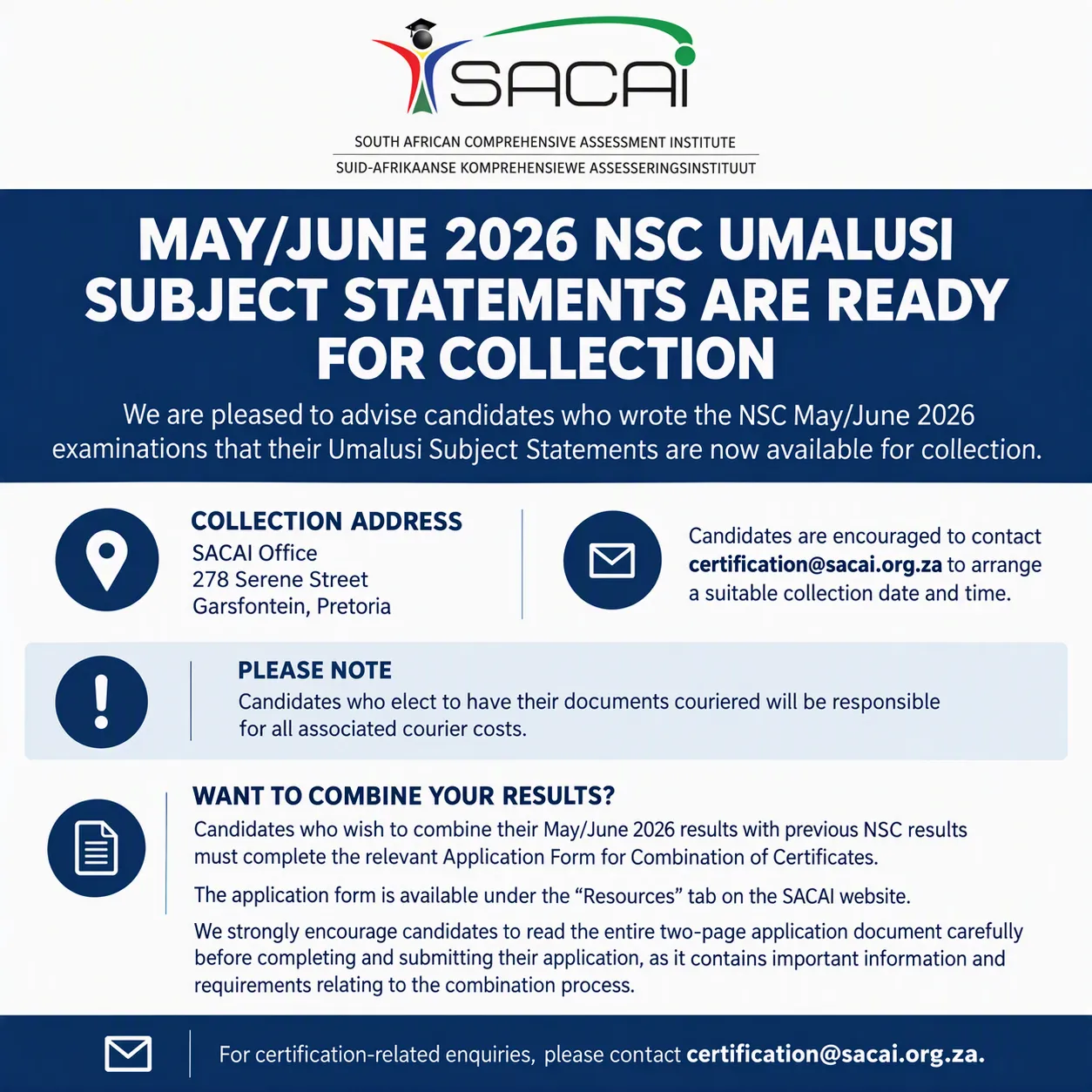
Should a candidate not have met the requirements for the NSC qualification (thus failed Grade 12), a Subject Statement will be issued by Umalusi. This document reflects the subjects in which the candidate met the minimum requirements.
You can apply to have your examination paper(s) re-marked, or you can apply to write the May/June examinations (should you meet the requirements) in an effort to improve your results.
NSC matric certificates are issued by Umalusi and are usually available by July of the year following your final examinations. The certificates are sent to the institutions at which candidates were registered. Candidates must thus approach their school/distance education provider in July of the year following their Grade 12 examinations to arrange to collect the certificate.
Standardisation is the moderation process used to mitigate the effect of factors other than candidates` knowledge and aptitude on their performance. The standardisation of examination results is necessary to take care of any variation in the standard of the question papers, which may occur despite careful moderation processes, as well as variations in the standard of marking that may occur from year to year. Other sources of variability include undetected errors and candidates` interpretation of questions.
After each examination cycle, the following takes place:
The NSC May/June Examination is an opportunity for candidates who wrote the NSC in the previous year and qualify to rewrite one or more subjects. Candidates must have a complete SBA record.
Details on how to apply to write the May/June Examination will be available on the back of your Statement of Results, and on the SACAI website (www.sacai.org.za).
VERY IMPORTANT:
A candidate who failed the NSC examination and does not qualify for the May/June Examinations must re-enrol for the next November examinations at a SACAI-registered institution. Institutions registered with SACAI for the new year will be listed on the SACAI website. SACAI reserves the right to register and deregister institutions at any time, hence it is important for parents/guardians and learners to check with their respective institutions if they are registered with SACAI for the new year.
May/June Examination results
SACAI will issue a new statement of results to a candidate who wrote the NSC May/June examinations. The date for the release of the results will be announced by SACAI (usually early August), and the statement of results will be obtainable online via the SACAI Results Portal.
A combination of certificates refers to cases where a candidate wrote matric in more than one examination sitting. The candidate thus has two (or more) sets of certificates/subject statements issued by Umalusi that must be combined into one combined certificate in order to qualify for the National Senior Certificate (NSC) and have a new Umalusi certificate issued.
Complete the online form on SACAI’s website or email certification@sacai.org.za.
Submit:
SACAI will verify documents before requesting payment.
It takes approximately 12 weeks for a new certificate to be issued. That is, 12 weeks from the date that all supporting documents were submitted to SACAI.
IMPORTANT: With combination requests, it often happens that candidates submit their application forms in the January following their second exam sitting. The problem, however, is that Umalusi matric certificates are only issued in June/July of the year following your exam sitting. Therefore, the 12-week processing time will only commence from the date in June/July after the second certificate has been issued by Umalusi and submitted to SACAI.
SACAI will inform you when the new certificate is ready for collection from the SACAI offices in Pretoria. Kindly note that, for security reasons, certificates must be collected from SACAI. You are welcome to arrange that a courier collects on your behalf if need be. Please inform SACAI of any such arrangements.
SACAI will issue a combination letter upon request. This letter will reflect the results that are being combined and can be submitted to universities/employers together with your two certificates as proof that a new Umalusi certificate will be issued in due course.
Apply directly to Umalusi for a replacement.
The National Senior Certificate (NSC) is a Level 4 qualification on the National Qualifications Framework (NQF). It is awarded to Grade 12 candidates who meet the requirements outlined in the National Policy pertaining to the Programme and Promotion Requirements of the National Curriculum Statement Grades R–12.
The NSC is a three-year qualification offered in the Further Education and Training (FET) phase (Grades 10–12).
Curriculum and Assessment Policy Statements (CAPS) are policy documents that outline the aims, scope, content, and assessment requirements for each subject in the National Curriculum Statement Grades R–12.
The amended Section 4 requirements was implemented by SACAI in 2021.
3 Subjects passed with 40% or more (including the Home Language) and 3 subjects passed with 30% or more. Learners may fail one subject, provided there is full evidence of the SBA having been completed.
Promotion takes place when a learner adheres to the minimum pass requirements as per the NPPPR paragraph 29:
Yes. Subject changes are allowed under these conditions:
Umalusi is the Quality Council responsible for quality assurance of qualifications in the General and Further Education and Training sub-framework of the National Qualifications Framework.
Please visit www.umalusi.org.za for more information about Umalusi’s role in education and training in South Africa.
SACAI is fully accredited by Umalusi as a private assessment body to assess the NSC and GETC: ABET qualifications.
Currently, DEPs are not accredited by Umalusi. They apply for a concession through SACAI to be acknowledged as institutions providing distance education to NSC learners, enabling these learners to be certified.
Parents/guardians and learners may not pay SACAI directly (except for specific services like May/June exams, spring school, remarks, viewing, or certificate combinations). All payments must go through the registered institution.
Parents/Guardians should address their financial queries to the school or distance education provider at which their child is registered.
No. Learners who fail matric may redo only the subjects they failed. After repeating, the certificate (results) must be combined into one NSC certificate.
SBA: Learners can choose to redo SBA tasks or keep the previous SBA marks.
Registration: Repeaters must register through a SACAI-registered institution; direct registration with SACAI is not allowed.
Learners who are repeating a specific subject can choose whether they would like to redo the subject’s SBA (site-based assessments) or not. In other words, do you want to redo all of the tasks, term tests and examinations, or do you rather want to use the SBA mark you attained previously and just write the final NSC examination in October/November?
Unfortunately, this is not possible. You will have to register with a SACAI-registered institution who will, in turn, register you with SACAI to write the NSC examination.