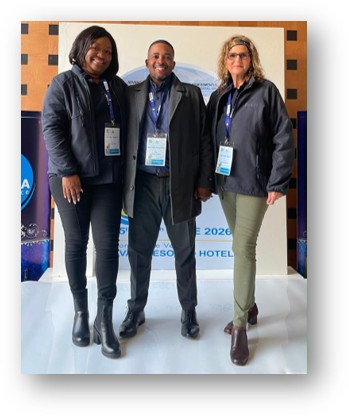
SACAI staff members attended an international academic conference from 15 – 18 June as part of the organisation’s broader commitment to strengthening its research capacity and upholding the research-related expectations linked to Umalusi accreditation. The conference provided a structured opportunity for staff to engage with current international research, assessment practice, quality assurance developments and emerging educational trends.
Educational assessment across Southern Africa is entering a period of significant change. Digital learning, artificial intelligence, curriculum reform and growing expectations around equity and inclusion are challenging assessment bodies to reconsider not only how assessment is conducted, but also how its credibility, fairness and relevance can be protected.
These themes were central to the 15th Conference of the Southern African Association for Educational Assessment (SAAEA), hosted by the Examinations Council of Lesotho (ECoL) under the theme:
Advancing Responsive Educational Assessment for Diverse Learners’ Needs in the Digital Era
The conference brought together assessment professionals, researchers, policymakers and examination bodies from across the Southern African Development Community (SADC), with additional international participation.
For SACAI, the conference provided an important opportunity to benchmark current thinking, engage with emerging research and consider how developments across the region can inform the continued evolution of our own assessment approaches and processes.
Assessment in a changing educational environment
A central message throughout the conference was that the learner and the learning environment have changed. Learners increasingly engage with education through digital platforms and are developing knowledge and skills in environments that look very different from traditional classrooms. Assessment systems consequently need to respond to these changes while continuing to uphold the fundamental principles of validity, reliability, fairness and credibility.
This creates a difficult but necessary balance: assessment bodies must embrace innovation without allowing innovation to undermine standards. The challenge is therefore not simply to digitise existing assessment practices, but to consider whether assessment itself remains appropriate for the competencies, learning environments and learner populations it is intended to serve.
Inclusion must be designed into assessment
Equity and inclusion emerged as particularly important themes.
Professor Paseka Andrew Mosia of the National University of Lesotho challenged delegates to consider the extent to which education systems genuinely accommodate vulnerable learners. His keynote highlighted barriers associated with language, disability and educational models that may not adequately reflect African contexts.
A significant shift evident in both the keynote discussions and research presentations was the movement from assessment accommodation towards intentionally inclusive assessment design. Rather than addressing learner diversity only after an assessment has been developed, assessment bodies are increasingly being encouraged to consider accessibility and diversity during the design process itself.
For SACAI, this reinforces the importance of continuing to review approaches to modified assessment and exploring how inclusive assessment principles can be embedded more systematically into assessment development.
Curriculum reform requires assessment reform
Another recurring message was that curriculum reform cannot take place independently of assessment reform.
Professor Matšeliso Mokhele-Makgahlwa of the University of the Free State questioned whether competency-based curricula can genuinely succeed if classroom practices remain largely unchanged. Her presentation emphasised the importance of lifelong teacher development, professional learning communities and the use of assessment not only to measure learning, but also to actively support teaching and learning.
As curricula increasingly incorporate competencies such as digital literacy, problem-solving and other twenty-first-century skills, traditional assessment approaches may no longer be sufficient on their own. Assessment design therefore requires ongoing review to ensure that what is assessed — and how it is assessed — remains aligned with what learners are expected to know and be able to do.
Digital transformation is more than technology
The increasing use of technology within education was reflected throughout the conference, including in research on online assessment, digital assessment methodologies, cybersecurity, artificial intelligence and quality assurance.
Professor Ntsibane Ntlatlapa of the University of the Witwatersrand argued that digital transformation should be understood as a systemic organisational journey rather than simply the introduction of new technology. This requires careful attention to governance, cybersecurity, broadband infrastructure, secure data exchange and data sovereignty, particularly where cloud-based systems are involved.
The implication for assessment bodies is significant. Introducing digital assessment requires much more than choosing the appropriate platform. Policies, quality assurance systems, security protocols, governance arrangements and organisational capabilities must evolve alongside the technology.
Digital transformation is therefore not a once-off project. It is an ongoing process requiring deliberate planning, monitoring and adaptation.
Artificial intelligence: opportunity and risk
Artificial intelligence featured prominently throughout the conference and is becoming increasingly difficult for education and assessment bodies to ignore.
The discussions recognised AI as both an opportunity and a risk. Used appropriately, AI may support teaching, learning, assessment development and administrative processes. At the same time, it introduces important questions around academic integrity, authenticity, fairness, data governance and the credibility of assessment outcomes. The emerging position was not that assessment systems should attempt to resist AI, but rather that policy and governance need to develop quickly enough to enable its responsible and ethical use.
For SACAI, this reinforces the need to monitor developments in AI closely and continue developing governance approaches that allow innovation while protecting the integrity of assessment.
Governance remains central to public trust
Technology may change how assessments are developed and delivered, but the foundation of educational assessment remains public confidence.
A conference panel on governance, quality assurance and resource stewardship highlighted the importance of transparent standards and consistent decision-making. Inconsistent application of rules or sanctions can create perceptions of subjectivity and ultimately undermine confidence in qualifications. The panel also emphasised that expanded access should never come at the expense of assessment standards.
One of the strongest messages was that educational qualifications can be regarded as a form of international currency. Their value depends on the confidence that institutions, employers, learners and the broader public place in the systems responsible for awarding them.
Investment in assessment quality should therefore not simply be regarded as an operational cost. It is an investment in the credibility of the education system itself.
What the conference means for SACAI
Perhaps one of the most valuable insights from the conference was the recognition that many of the challenges currently being considered by SACAI are shared by assessment bodies throughout Southern Africa. Questions concerning online learners, digital assessment, modified assessment, artificial intelligence, assessment security, quality assurance and examination integrity are increasingly common across the region.
The conference consequently reinforced several areas for continued development within SACAI:
• strengthening policy frameworks for online and digital assessment;
• reviewing approaches to modified and inclusive assessment;
• expanding research into digital assessment methodologies;
• enhancing quality assurance for technology-enabled assessment;
• monitoring developments in artificial intelligence and their implications for assessment;
• strengthening governance, cybersecurity and examination-integrity frameworks; and
• ensuring that assessment approaches continue to evolve alongside curriculum reform.
Continued participation in SAAEA also creates opportunities for SACAI to benchmark its practices against other assessment bodies, contribute to regional policy discussions and learn from the experiences of institutions confronting similar challenges.
Looking ahead
The 15th SAAEA Conference demonstrated that educational assessment is undergoing significant transformation. Future assessment systems will need to balance innovation with credibility, accessibility with quality, and technological advancement with effective governance.
For SACAI, the conference provided reassurance that many of the strategic questions currently being explored are part of a broader regional and international conversation. More importantly, it reinforced the value of continued research, collaboration and proactive policy development.
Assessment practices will inevitably change as education changes. What must remain constant is the commitment to fair, credible and reliable assessment and to maintaining the public confidence upon which the value of qualifications ultimately depends.
At the conclusion of the conference, the Examinations Council of Lesotho assumed the Chairmanship of SAAEA, succeeding the Examinations Council of Eswatini. The transition marks a new chapter in regional collaboration and provides further opportunities for assessment bodies across Southern Africa to work collectively in responding to the changing educational landscape.
Photos below: SACAI staff on day 1 and day 2 of the conference. From left to right: Ms Chipo Chibaya, Mr Faizel Mahlangu, Ms Ronel Smart